I am indebted to www.bento.com for their review of this place; I was in the neighbourhood after reserving a ferry ticket and needed somewhere that was open at 5pm on a Sunday. Not always an easy thing to find, unless you're willing to settle for something bland from a chain. This place also had the benefit of being a walk away in the depths of the Shiodome thicket of skyscrapers.
I didn't realise until I arrived that Din Tai Fung was in the same building as Bice, the wonderful southern Italian 'sky restaurant' where I had my birthday lunch. Still, as I walked past some sort of screechy faux-opera being staged in the sunken courtyard outside and joined the queue snaking along blond wooden stools outside the shopfront of the restaurant, I was intrigued to see what made this place so popular. An irreverent part of me from my days as a student of Spanish literature is always tempted to apply the first part of García Lorca's Llanto por Ignacio Sánchez Mejías, which keeps chanting 'a las cinco de la tarde' (meaning 'at 5pm') in an ever more ominous refrain, to restaurants: there is indeed no time that is more terrible or deathly in the search for a good meal. This makes it all the more noteworthy that Din Tai Fung had a line of people patiently waiting, despite the plethora of other, queueless restaurants in the building.
I guess they all knew a good thing when they smelled it. As I got closer to the entrance, shuffling along the bank of stools, my nose quivered slightly as the aroma of pork broth got stronger. It smelt rich, slightly fatty and unctuous; there was a definite note of spice, but that didn't diminish its meatiness. Din Tai Fung's signature dish is 'xiao long bao', steamed dumplings loaded with minced pork and a shot of intense meaty broth. I had read about how these were made before - the broth is solidified into aspic that then melts with the heat of the steam inside the dumpling - but hadn't had the chance to try them. The waitress also brought a laminated card of eating instructions in English, complete with cute little diagrams. Far from being patronised, I was glad to have the guide: it meant I could avoid committing some faux pas by eating them in my usual inadvertently uncouth fashion. I did as I was told and dipped the dumpling in soy sauce, manoeuvered it onto a china spoon with my chopsticks, pierced it and pressed it slightly to release the broth and layered some shreds of ginger on top - all this before eating anything! The first mouthful was sublime, though: the sharp fragrance of the ginger shards and the savoury hit of the soy sauce balanced the round, earthily soft meat and the shock of the hot broth in both taste and texture.
There were various other components included in my 2000 yen set meal: a small dish of mysterious nutty tofu with pickled greens, a large helping of prawn fried rice, an astringent lemon jelly which was significantly nicer than I expected from its rather unflattering photograph on the menu. The star act, though, was indisputably those dumplings. They came in two forms - four plain, and two whose wrappers had been twisted into a pineapple shape to hold the booty of fat prawns amidst their folds. I couldn't decide which I liked best. Next time - and I am sure I will be going back - I'd be very tempted by the boxes of dumplings they sell by the till to steam at home.
If this is typical Taiwanese food, book me on the next flight to Taipei...
Showing posts with label Restaurant reviews. Show all posts
Showing posts with label Restaurant reviews. Show all posts
Sunday, 2 May 2010

Tuesday, 27 April 2010
Restaurant Review: Arinomama
UPDATE: Having rushed there in vain to get in before last orders at 1.30 this afternoon, I have finally learned the name of this place: 'Arinomama', which means 'as it is' or 'frankly'. Rather a good name, don't you think?
I went to my favourite local restaurant for lunch today, and I'm ashamed to say I still don't know its name despite having eaten there more times than I can count. It never really seems important: I always describe it by its location (tucked away on a small side street behind the udon noodle restaurant, over on the other side of the level crossing over the railway), and besides, though I keep extolling its virtues to people, it's a rare occasion that I'm not eating there alone. This doesn't bother me in the slightest: one of the things I love about the place is that there are always several lone diners, treated with utmost respect and minimal distraction. The faint classical music in the background - real music, not Muzak - adds to the sense of tranquility.
Adding to my air of contentment is the wonderful food, served in pleasingly hefty quantities. The restaurants specialises in teishoku: meaning 'set meals', this results in a large tray being set in front of the diner, with a wide array of delights in little bowls. Teishoku has some essential components - rice, miso soup, pickles - but here they're distinguished by small superior touches. The miso soup is loaded with seaweed and cubes of fresh tofu; there are always three types of homemade pickles; the rice is so plentiful I always wonder if I'll manage to finish. Then there are the exciting extras: soft silken tofu, served with tiny shreds of spring onion and waiting for a slug of intense dark soy sauce to complete it. Crisp shredded cabbage with julienned red and yellow peppers, the occasional flavourful but unintrusive sliver of red onion, wide-hipped chunks of bloodshot tomato, peppy sesame dressing. Another vegetable side dish, this one typically earthier than the others, perhaps including some delicate spindly mushrooms, mellow carrot or slightly smoky aubergine.
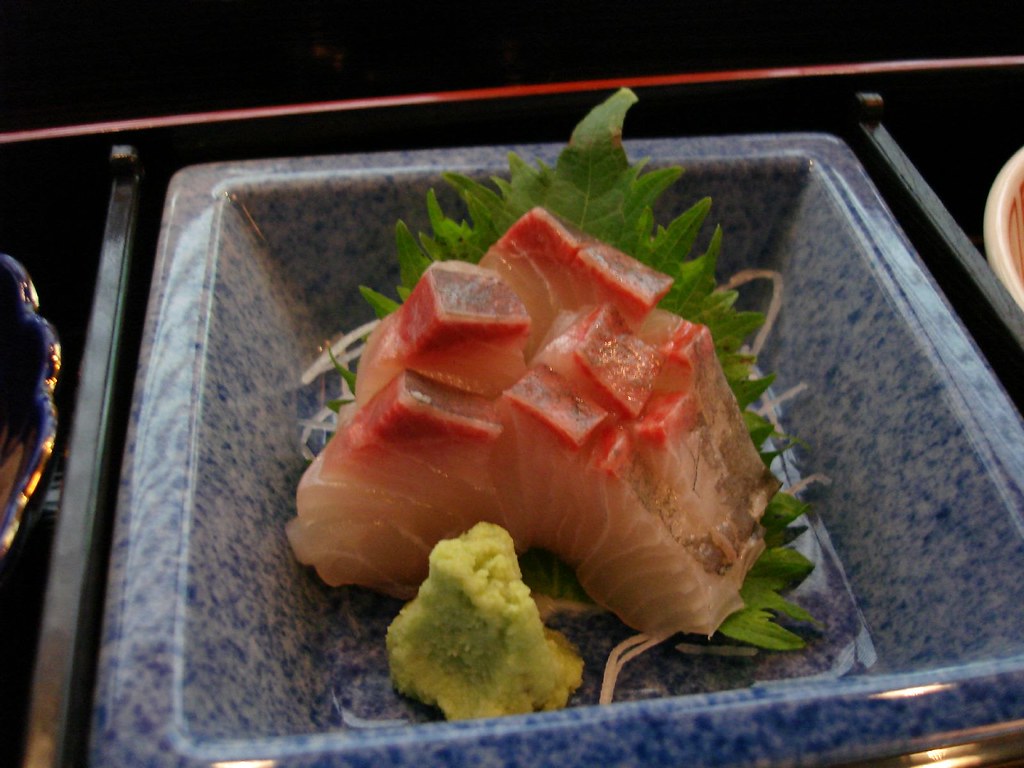
And all this without mentioning the star attraction: I've yet to encounter a main dish I haven't liked. As well as a respectably varied main menu (with a well-translated English version, I might add, which makes the whole experience a thousand times easier), there are five or six daily specials. A typical dish is 'buriteriyaki' (Japanese amberjack... no, me neither, and I don't think it would be that much help showing what it looks like when alive, as I've never seen it in that state either, so here's a picture of it in sashimi form), luscious, unctuous fleshy fish, almost completely devoid of the kind of bones that used to plague the Queen Mother (RIP), served in a deep brown, slightly sweet, rich sauce.
Today, though, I had my all-time favourite: tomato gyouza dumplings. As far as I can tell, this is a rare venture into fusion cookery; my fumbling attempts at description have invariably resulted in baffled expressions on Japanese people's faces, and as this confusion has persisted even when I've spoken English, I think I can safely assume it's the dish rather than my explanation which is new to them. The dumplings are remarkably simple: a slender sliver of pork, ribboned with a healthy amount of fat, is wrapped around a chunk of the same sort of tomato that goes into the salad. This bundle is then enveloped in a thin wrapper of soft, slippery dough, making a half-moon shape. The whole caboodle is then fried, forming delicious and cholestrol-heavy crispy bits where they've been left to sizzle in the pan. Dipped in soy sauce mixed with a little chilli, they are wonderfully comforting - punchy yet familiar-tasting, with bite but soft enough to gobble shamelessly.
The experience is completed by a bottomless ceramic handleless cup of murky brownish green tea, which has a miraculous capacity to clear the mind and is thoughtfully served from a Thermos-style dispenser left on the table so you can have as much as you like. There is also cold draft beer or a considerable range of shochu or sake if you're more inclined towards dipsomania. There are even three choices for dessert: carrot cake (which emerges as a curious mixture of carrot cake and corn bread because of its use of carrot juice rather than grated carrot), tangerine jelly or creme caramel. And all of this comes for a base price of under 1000 yen - no more than seven pounds for a feast of Japanese culinary treats, and not much more if you add drinks and desserts to the mix. If there's anywhere better for a weekday dinner, I defy you to show me where...
I went to my favourite local restaurant for lunch today, and I'm ashamed to say I still don't know its name despite having eaten there more times than I can count. It never really seems important: I always describe it by its location (tucked away on a small side street behind the udon noodle restaurant, over on the other side of the level crossing over the railway), and besides, though I keep extolling its virtues to people, it's a rare occasion that I'm not eating there alone. This doesn't bother me in the slightest: one of the things I love about the place is that there are always several lone diners, treated with utmost respect and minimal distraction. The faint classical music in the background - real music, not Muzak - adds to the sense of tranquility.
Adding to my air of contentment is the wonderful food, served in pleasingly hefty quantities. The restaurants specialises in teishoku: meaning 'set meals', this results in a large tray being set in front of the diner, with a wide array of delights in little bowls. Teishoku has some essential components - rice, miso soup, pickles - but here they're distinguished by small superior touches. The miso soup is loaded with seaweed and cubes of fresh tofu; there are always three types of homemade pickles; the rice is so plentiful I always wonder if I'll manage to finish. Then there are the exciting extras: soft silken tofu, served with tiny shreds of spring onion and waiting for a slug of intense dark soy sauce to complete it. Crisp shredded cabbage with julienned red and yellow peppers, the occasional flavourful but unintrusive sliver of red onion, wide-hipped chunks of bloodshot tomato, peppy sesame dressing. Another vegetable side dish, this one typically earthier than the others, perhaps including some delicate spindly mushrooms, mellow carrot or slightly smoky aubergine.
And all this without mentioning the star attraction: I've yet to encounter a main dish I haven't liked. As well as a respectably varied main menu (with a well-translated English version, I might add, which makes the whole experience a thousand times easier), there are five or six daily specials. A typical dish is 'buriteriyaki' (Japanese amberjack... no, me neither, and I don't think it would be that much help showing what it looks like when alive, as I've never seen it in that state either, so here's a picture of it in sashimi form), luscious, unctuous fleshy fish, almost completely devoid of the kind of bones that used to plague the Queen Mother (RIP), served in a deep brown, slightly sweet, rich sauce.
Today, though, I had my all-time favourite: tomato gyouza dumplings. As far as I can tell, this is a rare venture into fusion cookery; my fumbling attempts at description have invariably resulted in baffled expressions on Japanese people's faces, and as this confusion has persisted even when I've spoken English, I think I can safely assume it's the dish rather than my explanation which is new to them. The dumplings are remarkably simple: a slender sliver of pork, ribboned with a healthy amount of fat, is wrapped around a chunk of the same sort of tomato that goes into the salad. This bundle is then enveloped in a thin wrapper of soft, slippery dough, making a half-moon shape. The whole caboodle is then fried, forming delicious and cholestrol-heavy crispy bits where they've been left to sizzle in the pan. Dipped in soy sauce mixed with a little chilli, they are wonderfully comforting - punchy yet familiar-tasting, with bite but soft enough to gobble shamelessly.
The experience is completed by a bottomless ceramic handleless cup of murky brownish green tea, which has a miraculous capacity to clear the mind and is thoughtfully served from a Thermos-style dispenser left on the table so you can have as much as you like. There is also cold draft beer or a considerable range of shochu or sake if you're more inclined towards dipsomania. There are even three choices for dessert: carrot cake (which emerges as a curious mixture of carrot cake and corn bread because of its use of carrot juice rather than grated carrot), tangerine jelly or creme caramel. And all of this comes for a base price of under 1000 yen - no more than seven pounds for a feast of Japanese culinary treats, and not much more if you add drinks and desserts to the mix. If there's anywhere better for a weekday dinner, I defy you to show me where...
Subscribe to:
Posts (Atom)